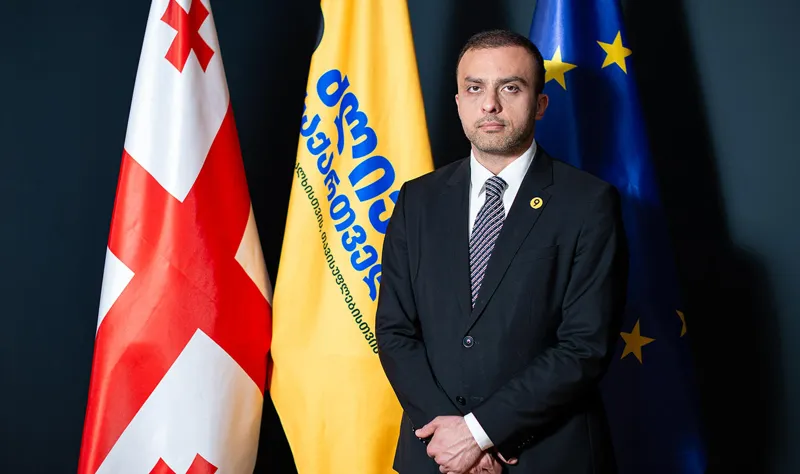
Tamar Oniani: There is an enormous risk that irreversible harm will be inflicted on Georgian democracy; the ban of parties is not a blow only against the opposition - this is a blow against the European future. I have no doubt that the Strasbourg Court will have its say

The lawsuit regarding the ban of political parties is a continuation of repressive mechanisms — this is not an isolated blow against the opposition; this is a blow against democracy and the European future of the country, — Chairperson of the Georgian Young Lawyers’ Association Tamar Oniani stated on the PalitraNews program “Day’s Newsroom.”
According to her, the aim of this lawsuit is also the continuation of the matter of protecting the presence of the ruling force in power.
“This is a continuation of those repressive mechanisms that we have been seeing from November 2024 until today. The main target of the repressions is free thought. Under free thought are understood institutional groups: the media, human rights organizations, the academy, politicians. This is not an isolated blow against the opposition, just as the ‘Russian law’ was not an isolated blow against the civil sector — this is a blow against democracy and the European future of the country.
Today in Georgia we have an acute crisis of human rights, which is characterized by the systemic persecution of the opponents of the ruling force, both by institutional persecution and by their individual persecution through criminal law mechanisms. In such a situation, the aim of this lawsuit is not the protection of democracy, but the continuation of the matter of protecting the presence of a specific ruling force in power,” Tamar Oniani noted.
She also explained that by its content the lawsuit regarding the ban of parties is political.
“Ultimately we have received a reality in which the 5 main opposition parties are threatened with abolition. This is an enormous risk that irreversible harm may be inflicted on Georgian democracy. This lawsuit has nothing in common with a legal process. Even the technical nature of the lawsuit is not such that we could say that we are dealing with some type of legal substantiation there. We see a compilation of certain events and ultimately a conclusion drawn that these parties are supposedly unconstitutional. We do not see reasoning according to which international and constitutional standard these parties should be banned.
Where is the source on which the 88 persons, the authors, base their own position that these parties are unconstitutional? This leads us to the assessment: in the name of protecting democracy, the presence of the ruling team in power is being protected. It is impossible in this process to separate the legal and political aspects from each other. By its content this lawsuit is political. Here I do not mean the deficiency of substantiation and so on,” Tamar Oniani noted.
She also added that yesterday’s session “was marked by the challenge that this lawsuit has — groundlessness,” which according to her “was also reflected in the conduct of the process.”
As Tamar Oniani notes, she has no doubt that after the ban of political parties the European Court will have its say.
“I do not think that any judge who wears a robe needs anyone’s advice to protect the Constitution. They have taken an oath in connection with this and they themselves are accountable with their own responsibility. Therefore, in this case, the taking of a decision that will ultimately ban the 5 main opposition political parties will be not only a blow against these specific opposition parties, but this means something far greater: this means Georgia’s even greater alienation from the European value order. I have no doubt that on this case the European Court will have its say. Precisely the European Court will be the court that will say that in the event that the ban of parties takes place, it is purely incompatible not only with any specific right, but with Georgia’s membership of the European family,” Tamar Oniani noted.
Tamar Oniani also added that in the lawsuit regarding the ban of political parties there is “an interesting entry, specifically on pages 11–12 the main phrase is written, which creates the feeling that the target of the lawsuit is not only these 5 opposition parties, but any other.”
“Several other parties are listed that today enjoy more or less popularity. The lawsuit says: ‘Since today they do not have sufficient influence on the political life of the country, the need for their ban does not stand, and as soon as they become stronger and have the possibility of crossing the barrier, this will also stand.’
A direct threat is embedded in the lawsuit, which for any judge should be that mine when he should understand that the aim of this lawsuit is specific settling of accounts in relation to the parties and the retention of power. In legal language this is called abuse of right,” Tamar Oniani noted.