Shalva Papuashvili: Why didn’t Paweł Herczyński go to the President to ask what damage the Palace sustained following the attack? He lacks the basic decency and awareness to even inquire about that - instead of lecturing others, he should explain why he supported violence!
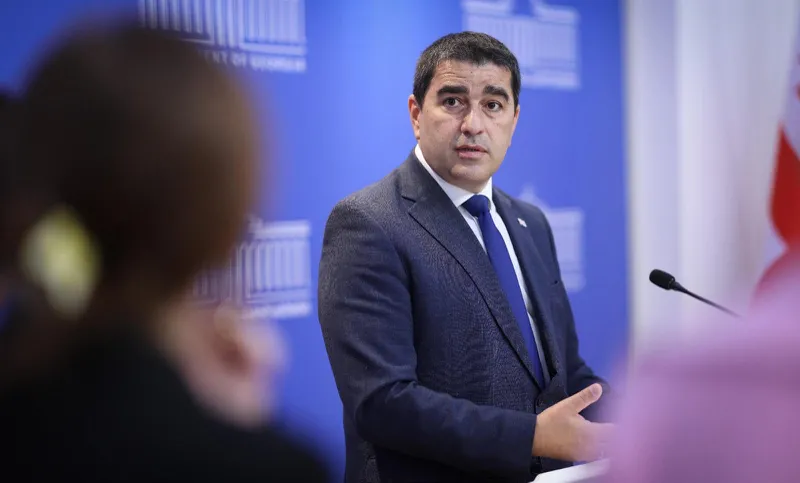
Instead of lecturing the Georgian people and trying to teach us lessons, Paweł Herczyński—acting as a primary overseer—should explain why he supported violence. He never once reached out to the President of Georgia; the EU Ambassador never even visited the President to ask how he was doing, or to inquire about the damage caused to the building—the Presidential Palace—following the attack. This individual is a guest in our country, yet he lacks the basic culture and awareness to check on the President of Georgia. The very people he supported attacked the Presidential Palace—this, despite the fact that, previously, he had met with Salome Zourabichvili (who has usurped the presidential standard) multiple times a month. This statement was made by the Speaker of the Parliament of Georgia, Shalva Papuashvili, regarding the EU Ambassador to Georgia, Paweł Herczyński.
He also addressed the critical assessment expected from the European Commission concerning Georgia. As Papuashvili noted, the report will contain nothing new or different from last year’s—nor could it, because Brussels has declared a boycott against Georgia.
"In fact, this is not even an assessment; it is a political communiqué that Brussels is publishing once again. This document has been used as a tool for an attack—an attack on Georgia, which is how we interpret what is written there. I would like to draw your attention to a few specific points. I am aware that the EU Ambassador has a briefing scheduled for today regarding this matter, so I am curious—perhaps he might have the time to answer me. Today is November 4; exactly 13 months have passed since October 4, 2025. Yet, to this day, neither the European Union nor the EU Ambassador has distanced themselves from the violence that occurred on October 4. To this day, the EU Ambassador has not condemned this violence; instead—as we also observed in the document—he is calling for the release of the perpetrators. To grasp the magnitude of this catastrophe, consider this: we now know that individuals who used Molotov cocktails to attack and set others on fire are referred to in France—a part of Europe—as 'people who attempted murder.' That is how they are described. In the case of Georgia, Mr. Herczynski—alongside the Commission’s document—is calling for the release of individuals who attempted to burn others alive. What is this, if not an incitement to violence, and a catalyst for further violence? Instead of lecturing the Georgian people like a schoolteacher, he should use his briefing to explain the statement made by the European Commission spokesperson regarding October 4, 2025—a statement that supported a gathering aimed at overthrowing the government, which ultimately led to violence and an attack on the Presidential Palace—an incident that Mr. Herczyński has yet to condemn," stated Shalva Papuashvili.
According to him, a second issue concerns individuals who sought plea agreements and petitioned the President for a pardon, thereby admitting their guilt; "yet, it is claimed that these people were 'arbitrarily detained'—this, too, constitutes an incitement to violence."
"Therefore, today we are seeking a statement—specifically from Paweł Herczyński—as to whether or not he condemns the attack on the Presidential Palace that took place on October 4, 2025. If he fails to provide a direct answer, it will be clear that both he and the European Commission are supporters and instigators of this violence. As for the courts, we have once again seen what certain bureaucrats in Brussels truly desire: they want to exert direct influence over Georgia’s judicial branch. To this end, they demand that judges in Georgia not be appointed in accordance with our Constitution, but rather by a foreigner—meaning that individuals like Rasa Juknevičienė should be the ones appointing our judges. They want this so that, in the future, no perpetrator of violence will ever have to face accountability..."
Instead of lecturing the Georgian people and trying to teach us lessons—acting as if he were some sort of chief overseer—Paweł Herczyński should explain why he supported violence and why the European Union funded a violent campaign centered on "Molotov cocktails." Furthermore, he never once checked on the President of Georgia; the EU Ambassador did not even visit him to ask how he was doing, or to inquire about the damage caused to the Presidential Palace following the attack. He is a guest in our country, yet he lacks the basic culture and awareness to even check on the President of Georgia. The very people he supported attacked the Presidential Palace. This is particularly striking given that, previously, he would meet with Salome Zourabichvili—who has usurped the presidential standard—several times a month, thereby creating the visual impression that she, rather than Mikheil Kavelashvili, is the legitimate President. Consequently, he bears responsibility—both through his complicity and his negligence—for the fact that an attack on the Presidential Palace took place. Therefore, there is only one thing I want to know from her briefing: 13 months have passed since the attack on the Georgian Presidential Palace. Let him state, directly and clearly, whether or not he condemns the attack on the Georgian Presidential Palace. Only then can we discuss the European Union’s assessments. Otherwise, we are dealing with a bureaucracy that supports perpetrators of violence—and until they change their rhetoric, it is difficult to have any meaningful conversation with them.
You can see what we are actually dealing with here: Kaja Kallas has effectively replaced our Constitutional Court, taking it upon herself to decide what is constitutional in our country and what is not. This is sheer audacity, and I hope Paweł Herczyński will comment on this brazen behavior. How dare an organization assume the role of the Constitutional Court and decide, regarding Georgia, what is constitutional and what is not? Who do they think they are—judges of the Constitutional Court?—to arrogate such authority to themselves? At today’s briefing, the Georgian people are interested in only one thing: will Mr. Herczynski adopt the stance of a 'governor-general' and start lecturing the Georgian people, or will he—once and for all—distance himself from violence, disavow attempts to interfere in Georgia’s internal affairs, and provide clarification on these matters?" stated Papuashvili.