“Both Formal and Informal Prime Ministers have Robbed this Country of a Historical Chance”- Irakli Alasania
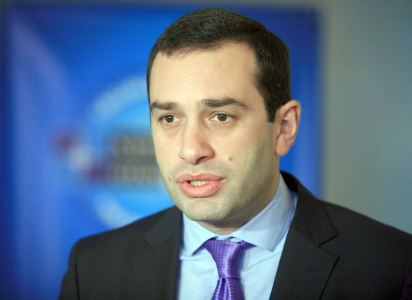
Former Minister of Defense Irakli Alasania is currently preparing for the 2016 elections and pinning a lot of hope on them. We sat down with him to discuss the latest issues and significant developments taking place both within and outside the country.
“In the future, when this government is no more, I intend to see this project brought to a conclusion,” says the former Defense Minister about the contract that cost him his post.
– Mr. Alasania, quite obviously, our first question will be about you and your party’s future plans. How do you plan to continue your political fight?
– Thank you for giving me opportunity to speak about this. We have already started rebuilding our party. We have meetings every week, coupled with trips to the regions and talking to the local population. We have also created an economic team. The people know our achievements in security and international diplomacy very well, and now the time has come to switch our focus to the economy. By the end of May we are going to come forward with our vision of economic development. In autumn we will offer a plan of achieving it, which will essentially mark the beginning of our election campaign. Aside from this, we are also devoting a lot of attention to education reform, because good education is an absolute necessity. Another such necessity is healthcare. The recent universal healthcare policy was positively received by society, but the quality of the service needs to improve.
As for our future partners, the powers that will enter the parliament need to be aware that they will be obliged to establish and hold political dialogue with each other. Even though my statements regarding the National Movement have caused quite a controversy, I still stand by what I said when I became a member of the opposition to Saakashvili’s government – the National Movement are a part of our society. However, I have to clarify that an alliance with them is out of the question.
– Your statement regarding the purchase of anti-air defense systems was met with a lot of interest. You claim that this contract has cost you your post; could you please elaborate what systems you were planning to obtain, at what price and how would they prove to be a guarantor of security for Georgia’s airspace?
– We began studying the combat data from the war in the 1990s and in 2008 since the moment I became Defense Minister. Eventually we came to a unanimous conclusion that obtaining anti-tank armaments and anti-air defense systems were our top priorities. Solving these two issues would allow our ground forces to defend our country far more efficiently. We spent a lot of time trying to break through the informal blockade that was imposed on us by the international community after the 2008 war. We tried to do that through negotiations with our partners such as USA, France and others. We managed to negotiate a deal with the French on the purchase of components for defensive anti-air systems. A lot of time and effort was put into this deal; it was made possible by our military’s participation in various international missions, namely in Afghanistan and Central Africa. Long story short, we came to a political agreement and created a memorandum.
As for the systems themselves, I will only describe them only in general terms, because in the future, when this government is no more, I intend to see this project brought to a conclusion. This is why in my previous statements I focused on the dangers these weapons could protect us from. Indeed, these are systems that would have served as a guarantee of Georgia’s aerial sovereignty anywhere within its borders; a mechanism that could have provided us with an opportunity to protect our population and infrastructure from short- and medium-range ballistic weaponry.
– By that you probably mean Russia, which can exercise control over the entirety of Georgian airspace through missile systems deployed at bases in Gyumri, Abkhazia and vicinity of Black sea?
– Precisely so. This is the very reason why this contract needs to be concluded. First, with protection of these systems, our ground forces will be able to carry out defensive operations without getting hampered by airstrikes. Second, their presence provides stability, which will have a positive effect on our economy, especially on foreign investments. And third, a gross imbalance in military, present in the region will more or less even out, making Georgia able of putting up a reliable defense if attacked. Keep in mind that I am talking only about defense here, which is our sovereign right. Our agreement made the purchase of these anti-air system components a long-term, concessional loan that was acceptable for Georgia and wouldn’t be a heavy burden on its budget. Payments were due after the project was brought to a conclusion. We haven’t lost the chance of achieving this yet, hence the reason I will not disclose which military industrial complex made the offer of supplying us. Also, we had full approval of the French President, which he gave us during the meeting in Tbilisi and repeated at the NATO Wales Summit.
– According to Mindia Janelidze, current Minister of Defense, there was no agreement signed with the French side, only a so-called letter of intention. For all senses and purposes, the memorandum you mentioned carries a declaratory quality and implies goodwill of the parties towards negotiations. He also claimed that consultations and negotiations with the French on the subject continue successfully. His claims are supported by Renaud Salins, the French Ambassador, who said that French military contractors have not signed any obligations with the Georgian side and that nothing but discussions took place. What is really happening and where is the truth?
– What we are dealing with here is a matter of very simple logic. The signing of an agreement is preceded by a letter of intention, or a memorandum, which signifies that both sides are ready to commit to the agreement and the only thing that remains is working the technical details out. A signed memorandum means that the main part, a political commitment, is already achieved. A financial obligation is signed afterwards. This is my main bone of contention with both the formal and the informal prime ministers: they failed to live up to the agreement outlined by this memorandum and thus robbed our country of a historical chance – at this stage, at least. As for the French Ambassador’s statement regarding there being no financial obligation, he is technically correct, but he should have added that a memorandum was signed nevertheless. This is my problem with him. There is no such thing as half-truths – you either say the whole thing or you say nothing at all.
– Now to the so-called “Cables Affair” and five of your arrested subordinates. The Prosecutor’s Office was in quite a turmoil when all this occurred. Rumor has it that the “Dream’s” dream was to have you imprisoned. Can you comment on that?
– This whole matter happened at Bidzina Ivanishvili’s order. It’s a pity that he has adopted the worst of Saakashvili’s practices: Usage of the Prosecutor’s Office for one’s own purposes. This is why I experience such a strong sense of injustice at the moment. They wanted me to cease the negotiations with the French, but when I continued them, as I was fully within my right to do so, they arrested these five people on the very same day I headed to France. It was an attempt to intimidate me into cutting the negotiations off. I am certain, however, that they will soon be released from prison and returned to their families and work. Their lawyers’ statements affirm my hopes. Then, of course, it will be asked why and on whose orders the Prosecutor’s Office arrested these people, and the duty of providing an answer to this will fall upon Bidzina Ivanishvili.
– What is your relationship with the government like at the moment and how capable of resistance do you think their political coalition will prove? According to surveys by IRI, universal healthcare is a big political advantage of theirs, but they lose points due to lack of professionalism. What is your own evaluation?
– What we are currently dealing with is the erosion of state institutions. They have ceased being responsible for their decisions. Governing the state is now all about obedience rather than mutual respect, which causes it to stagnate. This is Ivanishvili’s handiwork and it would be far better if he took the Prime Minister’s office again; this would at least lend his actions legitimacy. Right now, PM Gharibashvili occupies his post only formally. In reality, he is nothing more than a mouthpiece because all decisions are made by Ivanishvili. The same goes for our mayor – the real mastermind behind him is Mr. Kumsishvili. This is also true for all other state structures, and the results of this are there for all to see.
– Speaking of results, what can we expect in return for the political concessions that our current government made to Russia in order to normalize relations? We would also like to know what your views on this issue were at the time?
– We used to call that “pragmatic politics.” Not a single step should be made at the expense of Georgia’s security, but we should have a dialogue with everyone, including Russia. Lately there was some talk about a trade relationship, and for this reason, we supported the Abashidze-Karasian dialogue format between Georgia and Russia. However, the moment Zurab Abashidze mentioned the NATO training center, the Kremlin responded that no NATO infrastructure should be placed in Georgia. This has only deepened our suspicion of the country’s Euro-Atlantic choice being in danger. As for Russia’s position, our concessions had no real results. On the contrary, the “agreements” Moscow signed with Abkhazia and Tskhinvali have only worsened the situation. However, our main goal should be to avoid any premise that can drag us into a confrontation. Besides, we should use all the international leverage we have – the UN, the Geneva format and so on. I see a break in the tense relationship between our countries only in a post-Putin Russia.
– Do you think that the next generation of Russians will possess a neutral outlook on the post-Soviet countries in general and on Georgia in particular?
– I am not naïve enough to think that this will change on the very day that Putin stops being in power, but I have a hope that in the future Russia will be ruled by people who were educated in the West, who have lived there and who know what democracy is. Naturally, this would bring about a change in the country’s foreign policy. I believe there will be a time when Russia and Georgia are able to consider each other good neighbors.