Shalva Papuashvili releases open letter titled “Putting perceptions before facts should not be the West’s approach to Georgia”
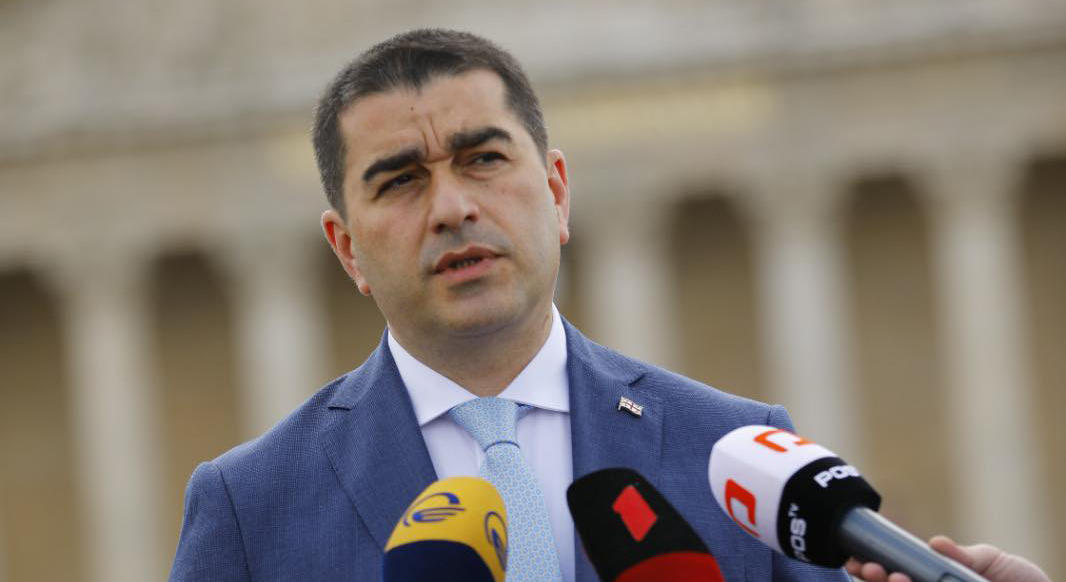
The sheer scale of the Saakashvili health scam and the subsequent political fallout tells us two things: First, there is virtually no boundary to Georgia’s radical opposition’s lies. And second, more important, our foreign partners are perfectly capable of succumbing to false perceptions, thus undermining the trust in our relations, - reads an open letter released by the Speaker of the Parliament of Georgia, Shalva Papuashvili.
According to him, some of the foreign politicians, especially in the European Parliament, owe an apology to the Georgian people.
“The belief that “perceptions are more important than facts” has done a huge disservice to some of our foreign partners, who fell victim of Mikheil Saakashvili’s large-scale disinformation campaign.
Former Georgian president and erstwhile Ukrainian public servant, Saakashvili, has just announced his ‘comeback’ to Georgian politics. This dramatic announcement came at the background of the allegations of him ‘lying on his deathbed’ for months and months. In the first place, he has never been seriously ill and never left Georgian politics. Also, his ‘comeback’ is entirely inconsequential. But, apart from these simple truths, this political move is a reminder of a huge problem in Georgian politics: the scale of lies, which then translates into perception about the ‘backtracking’ of Georgian democracy.
Our partners often wonder why there is such a noticeable gap between Georgia’s impressive democratic achievements, on the one hand, and the country’s (mis)perception abroad, on the other hand. Indeed, over the last ten years, unlike the previous decades, Georgia has made enormous strides in democratic development. Yet, the outward image, created by the opposition’s political radicalism, obscures many achievements of Georgian people and government.
How can we account for this gap between perception and reality? The Government’s explanation that the misperception is mostly a result of the radicals’ premeditated and well-coordinated defamation campaign, apparently, does not break through the wall of Western skepticism. The very scale of disinformation makes it difficult for some of our Western partners to believe that there is such little substance behind the massive anti-government defamation campaign. The only tool the Government has in its arsenal of countering disinformation is to rely on numerous authoritative rankings, ratings, and polls that indicate Georgia’s progress and the people’s support for the government. Nonetheless, our partners often tell us what has become an unfortunate mantra of Georgia’s foreign relations: “perceptions are more important than facts”.
Now, with Saakashvili’s ‘recovery’ and ‘comeback’, we have a unique case that illustrates how massive and well-coordinated is the disinformation machine that works against the Georgian government. Facts first: Over a year and half ago, on 1 October 2021, Saakashvili illegally smuggled himself into Georgian territory. He was arrested for the two crimes perpetrated during his tenure as president. He had already been tried and sentenced by all three instances of Georgian courts by 2018. Almost immediately after Saakashvili’s arrest, speculations about his health have abounded. He was transferred from prison to a comfortable prison clinic, with very good medical care and generous access not only to his family, but also to his political subordinates. Saakashvili himself, his family, his radical Georgian and foreign supporters, subordinated political media, and affiliated non-governmental organizations incessantly alleged that Saakashvili was ‘about to die’ and ‘on the verge of death’ with dozens of incurable diseases, including dementia, cachexia, depression, etc. Most vicious part of these allegations implicated the Georgian government in ‘poisoning’ Saakashvili, alluding to the methods used by the Kremlin against its political opponents.
The reaction from abroad was ample and loud: European diplomats came with demarche to the minister of justice of Georgia; three resolutions by the European Parliament called on Georgian Government to stop mistreating Saakashvili; Russian human rights activists incorporated Saakashvili’s case into their agenda and the authors of the Magnitsky list became his ardent advocates; presidents of Ukraine and Moldova expressed their solidarity; innumerable articles were published in foreign press and most renowned TV companies and publications covered the ‘issue’. Domestically, the radical parties under Saakashvili’s wing made his health the top item of their political agenda. Numerous attempts were made to mobilize large groups of people to show solidarity with Saakashvili. His supporters even announced the plans of his forceful extraction from the clinic where he serves his sentence. Except, people never came to demonstrate on behalf of Saakashvili because Georgians, unlike some foreigners, stopped believing him a very long time ago.
Georgian government acted as it should: the responsible agencies assured the public and foreign politicians that Saakashvili’s conditions of detention were adequate to his requirements. Government rebuked all allegations in due course. Evidence was presented about Saakashvili’s true health condition as well as his continuous attempts at self-harm, which he tried to present as government’s deliberate actions to hurt him. However, despite the government’s efforts, the perception of ill-treatment persisted, especially abroad.
Then, the truth started to emerge slowly. The first major revelation was made thanks to the Foreign Agents Registration Act (FARA) in U.S., which published the contracts between Saakashvili’s family, on the one hand, and a law firm Akerman and a public relations company on the other hand. On Saakashvili’s behalf, they lobbied for his release worldwide. The amount paid for these efforts was colossal for Georgian politics – up to a million and half American dollars. These contracts revealed the scale of lobbyism and coordination of efforts to help to release Saakashvili from his lawful detention.
Then, recently, the European Court of Human Rights (ECHR) in Strasbourg has ruled, decidedly, against Saakashvili’s appeal to be transferred abroad (or to another facility) for medical treatment. This ruling was a very clear and loud verdict against the allegations of mistreatment by Georgian government. It silenced many radical voices inside the country, and helped to alleviate the misperception about Saakashvili’s ‘mistreatment’. And, finally, Saakashvili himself delivered a coup de grace to his own reputation by suddenly declaring himself fit for active political duty and calling for the ‘unity’ of radical opposition forces to get rid of Georgia’s legitimate government. Surely, this final step has put in awkward position all those politicians, inside and outside of Georgia, who rang alarm bells about the government’s mishandling of Saakashvili’s treatment or, even worse, accused the government of deliberately harming Saakashvili.
But what do we get in the end of the day? A giant disinformation campaign that came, ironically, from the West not the North as expected, harmed Georgia’s reputation worldwide. For months, this disinformation, cooked up in back and forth between domestic and foreign actors, kept the country in an agitated state, in times when Georgia had much more important problems to salve, both geopolitically as well as with respect to the EU integration.
Foreign politicians, who repeated and shared this disinformation, knowingly or not, contributed to malevolent campaign against Georgia. I believe, some of these politicians, especially in the European Parliament, owe an apology to the Georgian people.
Ultimately, the sheer scale of the Saakashvili health scam and the subsequent political fallout tells us two things: First, there is virtually no boundary to Georgia’s radical opposition’s lies. And second, more important, our foreign partners are perfectly capable of succumbing to false perceptions, thus undermining the trust in our relations”, reads the letter.