


Grigol Gegelia: Flying the Georgian flag in Moscow is complete nonsense, but in Tbilisi the Russian flag is flying in the form of Kobakhidze
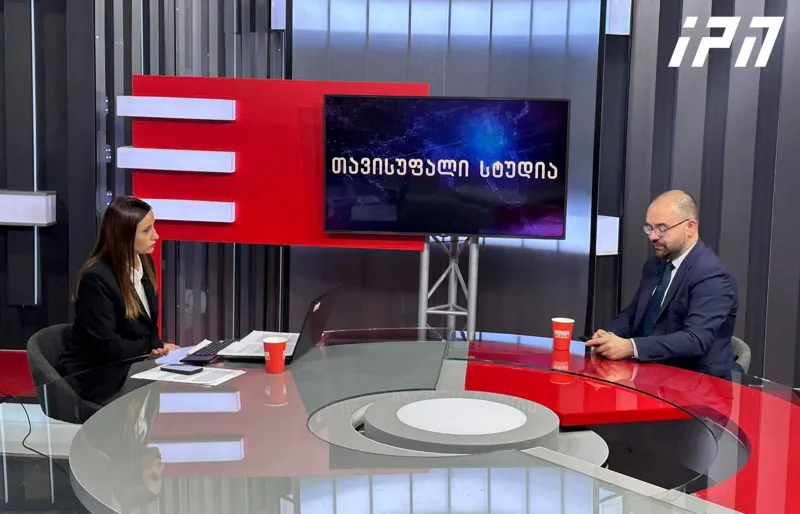
"Flying the Georgian flag in Moscow is complete nonsense, while in Tbilisi the Russian flag is flying in the form of Kobakhidze," - this is how Grigol Gegelia, Foreign Secretary of Strong Georgia - Lelo, responded to Prime Minister Irakli Kobakhidze's statement that "hoisting the Georgian flag in Moscow is a wonderful event."
On PalitraNews's program Free Studio, Grigol Gegelia stated that the meeting between Giorgi Zurabashvili and Mikhail Galuzin took place under circumstances where Russia has not changed its traditional positions regarding Georgia by even an iota.
"Today, a Russian regime is represented in the Georgian Parliament and at the highest level in the State Chancellery of Georgia. The mask was torn off this regime precisely when Russia invaded Ukraine; prior to that, they managed to create a certain facade, but as soon as the goddess of history shifted the times, everything was exposed.
In reality, hoisting the Georgian flag in Moscow sounds tempting, but what is the context, under what circumstances? When the dilemma of occupation stands, Russia has not changed its traditional positions regarding Georgia by even an iota. If I saw a difference, that some chance existed, I would favor such talks too, but nothing is different. This force is an occupier, and if there is any difference, it is a deterioration. For the first time in history, a Russian citizen was appointed as the de facto president of Tskhinvali. Every aspect has worsened, and in such a situation, do we have any new basis? Has anything positive happened because of which being left alone face-to-face like this could be recommended?" Grigol Gegelia stated.
According to Grigol Gegelia, the meeting between Giorgi Zurabashvili and Mikhail Galuzin "is an attempt to launch a new phase of Georgia's capitulation."
"When the representative of the Prime Minister of Georgia goes to Minsk instead of Prague, that is a declaration that you are going to a capital openly affiliated with Russia to talk about geopolitics and regional security—this is already problematic. When no neutral party is represented—neither the US, nor Germany, France, Britain—when the format is not multilateral, you sit face-to-face and turn what was called an informal conversation into a formal conversation, this is already transitioning to another phase; this is called bilateral official negotiations. This is not what this format was originally created for—first called the Abashidze-Karasin format, and now called Zurabashvili-Galuzin. This is not a framework for informal talks; rather, everything is being done to officially conduct bilateral, face-to-face talks with Russia at the level of state flags. Moreover, this is being done in a context where, in parallel, they have destroyed relations with all Western partners, virtually declared that Georgia's foreign policy has changed, is no longer heading toward the European Union, and is at odds with every key partner," Grigol Gegelia stated.
According to Grigol Gegelia, the statements made by Parliament Speaker Shalva Papuashvili and Prime Minister Irakli Kobakhidze regarding the Zurabashvili-Galuzin format are "very confused, erratic, and unformed."
"To tell you the truth, I could make neither heads nor tails of that interview, though if you read all the statements Kobakhidze and Papuashvili made today, you will see very fundamental confusion there and see that they are not aligned on a single line. Apparently, they are receiving demands from Russia that they cannot speak about openly; fulfilling them would create an existential threat in this country, from which the people have not gone anywhere. Packaging things nicely and pulling the wool over some people's eyes does not mean the majority in Georgia thinks otherwise—the majority of Georgia is anti-Russian. They are actually afraid of their own people. They want to continue their political flirtation with Russia, while looking for a [suitable] working mode in which they can simultaneously reinforce their pro-Russian stance. Bidzina Ivanishvili is afraid of Russia—that one day he might drink tea and polonium might be found in the tea. He is afraid that if he does not satisfy Russia, he will face an existential threat, and therefore he is ready to bargain with national interests," Grigol Gegelia stated.










